

How Hands-On Learning Is Changing the Way Dentists Build Clinical Confidence
- appcodecitydentali
- Dec 24, 2025
- 2 min read
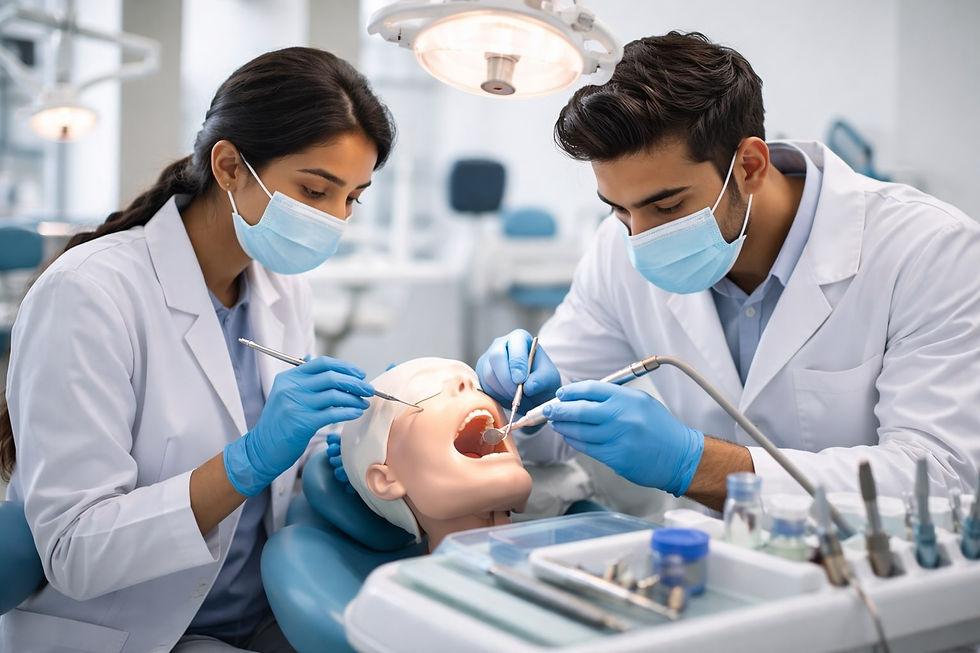
The journey from dental education to independent clinical practice is not always smooth. While dental graduates possess strong theoretical knowledge, many experience hesitation when treating patients on their own. This challenge has become increasingly common as dentistry evolves into a more skill-driven and patient-centered profession.
Today, dentists are expected to make accurate clinical decisions, communicate clearly with patients, and perform procedures efficiently. These abilities are developed primarily through practical exposure rather than textbooks, highlighting the importance of hands-on learning in modern dentistry.
Why Clinical Confidence Matters in Dentistry
Clinical confidence plays a vital role in patient outcomes and professional growth. Dentists who are confident in their skills are more likely to explain treatment plans clearly, manage complications effectively, and build long-term patient trust. On the other hand, lack of confidence can lead to treatment delays, referrals for routine procedures, or professional stagnation.
Confidence is not an innate trait—it is built through repeated practice, mentorship, and exposure to real clinical cases. This is where structured practical training becomes an essential part of a dentist’s professional journey.
The Role of Skill-Based Training in Dental Practice
Skill-based dental training focuses on real-world application rather than academic assessment alone. Such training emphasizes diagnosis, treatment planning, restorative procedures, and understanding how different dental disciplines interact during patient care.
Instead of learning procedures in isolation, dentists gain experience in managing complete cases, which better reflects real clinical environments. This integrated approach helps practitioners understand not just how a procedure is performed, but when and why it should be used.
Many dentists explore structured learning opportunities through institutions such as City Dental Institute, where practical exposure and guided clinical experience help bridge the gap between academic learning and everyday practice. Dentists interested in strengthening their hands-on skills can explore a well-structured dentistry course that focuses on applied clinical learning.
How Practical Exposure Improves Decision-Making
One of the most valuable benefits of hands-on training is improved clinical judgment. Real patient cases rarely follow textbook descriptions, and dentists must adapt treatment plans based on individual needs, limitations, and expectations.
Practical exposure allows dentists to encounter variations, manage complications, and learn from experienced mentors. Over time, this builds the ability to make informed decisions confidently, even in complex situations.
Long-Term Benefits of Continuous Skill Development
Dentistry is a continuously advancing field, influenced by new materials, technologies, and treatment techniques. Dentists who actively invest in skill development remain adaptable and professionally relevant.
Beyond technical improvement, hands-on training also enhances communication skills, workflow management, and ethical decision-making. These qualities contribute to better patient experiences and sustainable career growth.
Conclusion
As dentistry becomes more practice-oriented, hands-on learning is no longer optional—it is essential. Skill-based training enables dentists to transform theoretical knowledge into confident clinical execution. By focusing on practical exposure and continuous learning, dental professionals can build stronger foundations for long-term success in modern clinical practice.


Comments